• Home
  • Services
    • Hypnosis
      • Self Realization, Fulfillment and Expression
      • Goal Setting to Manifest
      • Relationship with Self
      • Heal Your Heart
      • Reduce and Rule Anxiety
      • Eliminate Fear
      • Optimum Health
      • Personal Achievement
      • Overcome Addictive Behavior
      • Relationships
      • About Hypnosis
    • Voice, Values and Vision Coach
    • Ceremonies and Rituals
      • Baby Welcoming
      • Maiden or Mensus
      • Wedding or Commitment
      • Crone or Grandma-hood
      • Letting Go or Release
    • Empowerment Retreats
    • Toe Readings
    • Emcee Like No Other
  • Classes & Programs
    • SoulCollage®
      • Introductory Class
      • Second Sunday Group
      • MeCards for Kids
      • Using Your Cards
    • New Moon Shadow Dance
    • Magnificent Mentor Groups
      • Dancing With Archetypes 2021 – Module 1
      • Your Life’s Blueprint
  • About You
  • About Barb
    • Hypnosis Disclaimer
    • Privacy Policy
    • What I Guarantee
  • Contact
    • Blog
    • Store
You are here:HomeBlog

The Perfect Response to an Orange River (5 of 10)

Aug 31, 2015 10:00 pm
Written by Barb Horn
0 Comments

The Perfect Response to an Orange River
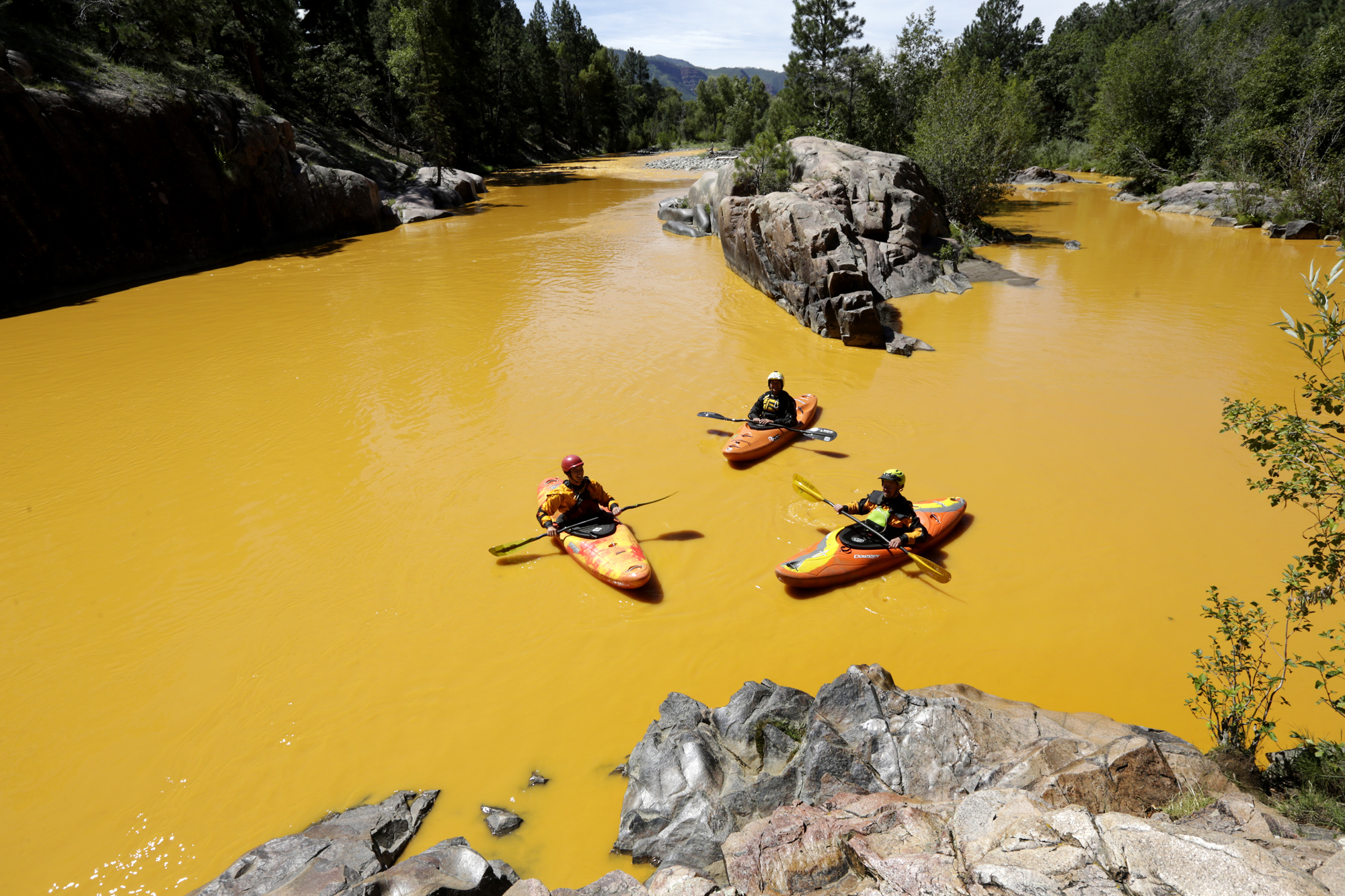
People kayak in the Animas River near Durango, Colo., Thursday, Aug. 6, 2015, in water colored from a mine waste spill. The U.S. Environmental Protection Agency said that a cleanup team was working with heavy equipment Wednesday to secure an entrance to the Gold King Mine. Workers instead released an estimated 1 million gallons of mine waste into Cement Creek, which flows into the Animas River. (Jerry McBride/The Durango Herald via AP) MANDATORY CREDIT

People Kayak the Animas River north of Durango, Thursday, August 6th, one day after the Gold King Mine spill.  Photo Jerry McBride, Durango Herald via AP

“Koyaanisqatsi” is the Native American Hopi word for life out of balance

This is the fifth in a ten part series called “Through the Lens of the Animas River” that explores the August 5, 2015 Animas River spill in southwest Colorado.  Each blog in this series looks at a different aspect and deeper story behind the spill.  All Embracing Change Blog is focused on change, how to create it, embrace it and in particular the relationship between paradigms of countries, cultures and collective humanity relate to the systems we build, the patterns we see and experiences we have.  All of those are change points, areas we can influence change but require different approaches and time scales.  Learn more about a change,  paradigm shifts or play Blame It Name It Change It or sign up for the All Embracing Change Newsletter.  The first blog was titled, “Who Really Turned My River Orange?” and second “How to Get Rid of the Environmental Protection Agency”, followed by “Is the Water in the Gold King Mine a Problem?” and “To Superfund or Not to Superfund Silverton.”

On August 5, 2015 the Environmental Protection Agency (EPA) accidentally released a spill of metals laden acidic mine water from the Gold King Mine.  This turned the Animas River orange and the entire country watch this butterscotch plume travel from Silverton, Colorado through Durango, on to Aztec and Farmington, New Mexico, then Bluff, Utah and into Lake Powell.  The plume also went through Southern Ute and Navajo Nation Tribal Lands.  The story went viral and international.  Perhaps that is because an orange river is an excellent visual story or maybe the irony that EPA caused a harmful spill and they are the agency responsible to protect us from such spills. I want to focus on response here, not communication and messaging. While that is a piece of response and important, I am talking about the response that generates what and how communication occurs.

From my perspective, the response was right on perhaps the best one could expect.  What it perfect?  No. Chaos is the nature of accidents, there is no order and perfection doesn’t exist.  A relevant question is was it enough?  Will the response satisfy everyone?  No and it shouldn’t.  The local and immediate response has to focus on immediate and local harm caused by the spill.  Harm that can be restored I believe will.  The very nature of accidents is that some things are forever changed and cannot or will not return to pre-conditions.  In some cases, it maybe the Mother Nature and time provide the best restoration possible.  Humans do not have a technological answer to every problem, despite what the media may lead us to think.  The local and immediate response will not fix the chronic broken systems that created the legacy mine issues and long term chronic exposures in the first place.  That will require a different response, one far beyond EPA’s resources and role.

This spill was an acute event like a boat flip or wrap.  In a flip, it is feels like time slows down, like slow motion, almost as if you are getting a moment to catch up to what is happening and about to happen.  It creates this pause in which you switch from denial to response.  You start to take in all that is around you, listen, ask, gather information, as reality settles in.  Throughout all of it, if you are going to survive, you are required to course correct in the moment.  Perfection doesn’t exist.

It is too early to know what went wrong at the site that day to cause the spill.  One EPA response is to conduct an internal audit and allow external audits.  This is an accountable response.  In addition, EPA froze all of their mining activities across the country.  As a boater who has been in a flip, you replay the flip a thousand times in your head, desperately searching for a reason, something that could take it all back.  Until you realize you can’t.  It is human nature to focus on what didn’t work.  Acceptance leads to an effective response, which leads to healing.  The headlines of the Durango Herald three days after the spill was “EPA: We’re Sorry”, the agency accepted responsibility then and there.  That acceptance allowed EPA, and others, to focus on an effective response.

The spill occurred at 10,000 feet, washed away the road to Silverton and was immediate for those in Silverton making a timely response challenging and the need for different emergency plans next time.  However, the spill took 30 hours to travel through the remote canyon and make it to the north end Durango.  It took even longer for the plume to reach the Southern Ute Reservation, Aztec and Farmington New Mexico, Bluff, Utah, the Navajo Nation and Lake Powell.  That is a lot of time in which to react.  And react the collective community did.  EPA, other federal agencies such as the Park Service, Tribes, state agencies, county governments, local health departments, irrigation, sanitation and drinking water provides, academia and non-profits all kicked into gear.   EPA brought in over 250 employees and that doesn’t count their contractors to address the multitude of issues.  It also many individuals and entities to coordinate.

Before the plume hit north of Durango, intake structures where shut down for irrigation and drinking water and the river was closed to all recreation.  The EPA arranged for air flights to follow the plume as it was impossible to drive and do so.  A local 24-hour crises center was created staffed in Durango and opened in all impacted communities.  This center became command central where collaboration occurred to gather data, share date, use data to make science based decisions, provide information to the public on health concerns, water supply, file damage claims, get water tested.  Radio stations provided updates hourly and newspapers daily.  EPA and Colorado Department of Public Health and Environment created webpages and sites to provide data and information.   Water was available and delivered to those without drinking or livestock water.  Live phone lines where available and public meeting were held.  Governors declared states of emergency to release funds for immediate needs such as drinking water. In Durango, a local fund that was initiated during the Missionary Ridge fire, was replenished and helped those make ends meet when they were left unemployed due to the river closure during the last big rafting week before school started.

Entities within their own jurisdictions began to collect pre-plume and post plume data.  On surface water, sediments, wells and water treatment and delivery systems, in irrigation ditches and in fish tissues.  I am personally impressed how each entity quickly arranged to collect data within its jurisdiction and how all that information came together eventually (still is) to address immediate concerns, such as opening ditches, drinking water supplies and recreation.  Colorado Parks and Wildlife (CPW’s) first response was to ensure hatchery fish were safe (hatchery water source is spring versus surface water).  Next we placed sentinel fish cages with rainbow trout fry in the river for 96 hours beyond the duration of the plume. Only one fish died not due to river conditions.  We collected wild fish for tissues analyses and are conducting fish population surveys.  CPW’s volunteer monitoring program has been sampling the Animas River for 15 years from Silverton to the state line.  Their data has been used to demonstrate improved conditions on the Animas River at Baker’s Bridge (photo) and will be part of long term monitoring.  Mountain Studies Institute did macroinvertebrate sampling pre and post plume.  Southern Ute Tribe placed continuous pH Sondes at two locations south of Durango.  Colorado Department of Public Health and Environment (CDPHE), assisted with public health sampling of wells, drinking water, ditches, surface water and sediment.  They also help coordinate meetings, staffed crises center, provide information and coordinate reopening’s.  It is still not clear all the data that has been generated and what long term monitoring is necessary.

The next tier of communication brought in a Colorado’s Congressman and Senator doing their job to make sure everyone else was doing their job. The Governor came and drank out of the river to show it was safe.  Gina McCarthy, administrator for EPA, came in person to confirm EPA is and will continue to take responsibility.  A presidential candidate even came to declare what they would do about this situation if they were president.  Attention from these figures made a difference for locals.

Orange rivers freak people out.  I had a dream the night the plume came through Durango that all the harmful things in our air and food were orange so people could see, that it could be that clear.  Closed rivers scare people.  Telling people that many of the metals settled out to the bottom of the river so the water itself is safe makes people fear the bottom of the river and what that means in the long term.  The river opened when data indicated levels of metals returned to pre-spill conditions. However, opening the river because water quality was similar to pre-spill conditions after you have spent days telling them that pre-spill conditions have had elevated metals for the past 50 years, upgraded everyone’s fears a notch or two.  Messaging is messy business.

People were angry, confused and inconvenienced.  Uncertainty fuels distrust.  People were unaware of the source of their drinking water.  Unaware that bottled water undergoes less testing than their own tap water.  Data was not easy to collect, analyze and communicate.  The metals of concern take time to collect and analyze.  The results are hard to explain.  Data must be verified, analyzed and then messaged.  The longitudinal nature of river and associated dilution, settling, changes in concentrations is difficult to measure much less explain that you cannot just “say what is in the water or sediments”, as many demanded, it depends where you are and when asking.   Weeding out impacts of this spill from historic spills and other mining activities, from urban impacts, grazing, non-point source and water quantity impacts in the short or long term may prove impossible.  This is a taste of what is being asked of the collective response.

The most important response the EPA, CDHPE and local entities did was have community meetings.  Websites and social media do not replace being in person. They held meetings before they had answers.  Staff at those meetings held the space for anger, frustration, confusion, uncertainty, and fear along with providing support.  That is not easy to do.  And then they came back. Once data began to come in and decisions made, these entities held more meetings to answer and explain what they could not.  They had experts available at tables to answer specific questions. They explained decisions to open ditches, drinking water sources and recreation.  The allowed people to disagree with decisions.  This spill happened on a scale where this was possible and staff from these agencies, federal, state and local came together and made it happen.  And it made a difference.  Perhaps because there was no manual how to respond, the best response was to listen and respond accordingly.  Plans can keep you from listening.

I am amazed at what was accomplished during the 14 days after the spill, it has been the kind of response that does go viral.  Primary ditches were open 9 days after the spill, secondary ditches 11 to-13 days after. The river to recreation opened 10 days after.  This is not the first spill the Animas has experienced but I hope it is the last, read about those High Country News.  I hope this never happens again to anyone, but if it does I am not sure any entity could beat the response.  I look forward to participating in monitoring and restoring long term impacts, leveraging momentum to approve a Good Samaritan legislation and an update of the General Mining Law of 1872 as well as discussion about Superfund in Silverton.  I know this, that if Superfund cleans up Silverton, Earthwork estimates there are 500,000 abandoned mines across the country requiring about 50 billion dollars.  And this doesn’t address the externalized devastation to rivers in other countries related to consumption in America or changes we can make now to reduce equivalent disasters related to climate change.  To address real change we need to change our paradigm so that systems we build, legal and otherwise, ensure resources and quality of life for the next seven generations of all peoples.  We can thank our Native American Tribes for reminding us of this.

Communication is usually a key area.  While communication is never perfect, disasters remove jurisdictional boundaries and create communication that usually doesn’t occur and show where communication links were not working and need to be fixed.  There is never one message because that depends on your question and area of concern.  Also, the answers change with time and so does what needs to be messaged.   There is also the messaging during the acute crises and messaging about recovery and long term change, different messages.  Finally, there are four types of people on the receiving end of message, all real, all valid but nevertheless impact how messaging is received. Group one are those who have resources and capacity to understand the complexity and information being messaged.  Group two are those who do not, but genuinely want to know, are open to listening, want the truth, realize “peace of mind” is a different baseline now and are ready to be part of a solution.  The third group are those that need to know and don’t know they need to know.  And the fourth group are those that have no intention of listening regardless of what is presented when, they use information exchanges solely to be heard, to get their agenda across, to maintain division and position and are not really looking for a solution. Communication is key for building trust and moving from post traumatic stress to post traumatic growth.  Communication requires both messaging and listening.

Part 6 of the “Through the Lens of the Animas River” blog series that explores the August 5, 2015 Animas River spill in southwest Colorado, is titled, “Hello Durango, where have you been?”

“We cannot be selfish or timid if we hope to have a decent world for our children and grandchildren.” Jimmy Carter.

To Superfund or Not Superfund Silverton? (4 of 10)

Aug 31, 2015 9:50 pm
Written by Barb Horn
0 Comments

To Superfund or Not Superfund Silverton?

People kayak in the Animas River near Durango, Colo., Thursday, Aug. 6, 2015, in water colored from a mine waste spill. The U.S. Environmental Protection Agency said that a cleanup team was working with heavy equipment Wednesday to secure an entrance to the Gold King Mine. Workers instead released an estimated 1 million gallons of mine waste into Cement Creek, which flows into the Animas River. (Jerry McBride/The Durango Herald via AP) MANDATORY CREDIT

People Kayak the Animas River north of Durango, Thursday, August 6th, one day after the Gold King Mine spill.  Photo Jerry McBride, Durango Herald via AP

“Koyaanisqatsi” is the Native American Hopi word for life out of balance

This is the fourth in a ten part series called “Through the Lens of the Animas River” that explores the August 5, 2015 Animas River spill in southwest Colorado.  Each blog in this series looks at a different aspect and deeper story behind the spill.  All Embracing Change Blog is focused on change, how to create it, embrace it and in particular the relationship between paradigms of countries, cultures and collective humanity relate to the systems we build, the patterns we see and experiences we have.  All of those are change points, areas we can influence change but require different approaches and time scales.  Learn more about a change,  paradigm shifts or play Blame It Name It Change It  or sign up for the All Embracing Change Newsletter.  The first blog was titled, “Who Really Turned My River Orange?” and second “How to Get Rid of the Environmental Protection Agency” followed by “Is the Water in the Gold King Mine a Problem?”

On August 5, 2015 the Environmental Protection Agency (EPA) accidently released a spill of metals laden acidic mine water from the Gold King Mine.  This turned the Animas River orange and the entire country watch this butterscotch plume travel from Silverton, Colorado through Durango, on to Aztec and Farmington, New Mexico, then Bluff, Utah and into Lake Powell.  The plume also went through Southern Ute and Navajo Nation Tribal Lands.  The story went viral and international.  Perhaps that is because an orange river is an excellent visual story or maybe the irony that EPA caused a harmful spill and they are the agency responsible to protect us from such spills.

Should Superfund be in Silverton?  What isn’t it?  The past 20 years of collaborative efforts where a waste, Superfund should have done the job in the first place.  These questions and statements have come and gone the past 20 years.  After the spill Durango and other downstream communities are now asking and even demanding, saying Silverton doesn’t have a choice anymore.

Superfund is an Environmental Protection Agency (EPA) funded program designed to fund clean ups of toxic wastes.  Billions of your tax dollars have been spent on Superfund sites since 1980.  Those sites toxic waste from abandoned mines, military operations, chemical or industrial storage sites and operations, power plants, uranium mills and other activities.

Some sites have identifiable owners and those owners have been required to contribute to cleanup of toxic wastes as well.  Many of those sites go through years of litigation in which funds that could be used to clean sites go into legal fees and lawyers accounts.  Sites without identifiable owners can be listed and remediated also.  Left over toxic wastes are external costs produced by systems created by a paradigm that says it is okay to do just that.  Blogs 1 and 2 explored this more.  Superfund as a program is a system, a reaction to the paradigm that caused the external cost of toxic waste.  Toxic waste are external costs because the entities that created it are not paying to remediate it and whatever was produced or profited off the site did not include the cost of cleaning up the toxic by product.

For the most part, the Superfund program has improved the environment, economy and other aspects where it has been implemented.  It does not and never will have enough funding alone to remediate the over 500,000 abandoned mines in America never mind toxic sites from other causes.

In Colorado Superfund came to another part of the state, Leadville, Colorado in the headwaters of the Arkansas River.  This was in the late 1980’s and early 1990’s.  There are effective ways to bring Superfund to a community and ineffective ways.  The EPA learned the hard way in Colorado, that coming to a small town that was built on a mining legacy, as an outsider and announcing that they were there to save the day and all of them from this very legacy, was less than effective.  This caused hard feelings and misperceptions, that later proved untrue. Allegations that Superfund designations lower property values and create a stigma for anti-tourism.  What is unsaid in these allegations is how repressed or property values when mine tailings are back yards and rivers in town are bright orange and void of life?   You can find evidence to support this if you look.  I started my water quality career at Parks and Wildlife working on this site.

In short, EPA had to do major damage control to make Superfund work in Leadville, but it worked.  Superfund designation is a partnership and works best with local support.   We explored the history of remediation efforts in Blog 3 of this series, where we learned Superfund was considered in the 1990’s in Silverton.  The Animas River Stakeholders, chose a collaborative voluntary approach to restoring the basin.  This group is a diverse group comprised of individuals, industry, local, state and federal agencies, nonprofits and academia.  They have no regulatory or voting authority.

If EPA wanted to force a Superfund designation in Silverton they have had many opportunities since the early 1990’s. As a member of the Animas Stakeholders Group, the EPA inquired a Superfund designation for legacy mine remediation in the early 1990’s.   EPA heard loud and clear everyone wanted to try the volunteer approach, especially because there were hundreds of mine and owners, not just one or two.  For the next twenty years, EPA supported this approach, provided resources and expertise.

Just like Leadville, Silverton was built on the sweat and blood, the rise and fall of the gold rush and it is rightfully proud of that heritage.  There is a wonderful and active historical society in Silverton that works hard to preserve this heritage, including a tour of old mines.   They are a Stakeholder member and have been essential in obtaining funding and efforts to restore and maintain relic structures during remediation. Leadville is home of the National Mining Hall of Fame and Museum.  Mining is an important part of Silverton. It has also contributed a tax base for the local economy over the years and can still in the future.

Still today, Silverton is divided among its approximate 600 year round residents.  As I write this, August 25th, almost three weeks after the spill that impacted their community, many do not want Superfund.  Their primary reason continues to be economic and perception.  Property values will decline and people will not come.   One of the loudest voices is an owner of San Juan Corporation, Todd Hennis, which owns the Gold King Mine.   He purchased the Gold King Mine in 1990’s and new his risks. He has been at odds with Sunnyside Gold Corp as to who is responsible for the water in the Gold King mine, see Blog 3 for more on this.  Todd Hennis does not live in Silverton, he lives in Denver, Colorado.  He has never lived in Silverton.  However, when he speaks at local meetings, he speaks as a citizen of Silverton.  This is misrepresentation and lacks transparency that would not be allowed or okay for others, such as the EPA.

What Todd is not saying, or some others, what is not being spoken out loud, is the fear that Superfund will shut down mining forever.  Hear profits.  When you cleanup a mine, even allow someone else to cleanup this mess, you cannot open that mine again.  There is nothing wrong with wanted to realize your investment, to want to mine and get more gold and profits out of your mines.  I can understand that, I can relate to your passion and investment in this area and industry.  Don’t insult me and hide behind false pretenses.  Only by putting all cards on the table can all cards be dealt with, anything short, people feel manipulated, used and trust is broken.

Once the truth is out, we can work with it.  We can work in a new paradigm, the world of AND.  I want Silverton to prosper.  I am fine with more gold being extracted, but not at more expense of the environment, and others people’s lives and livelihoods. Not under a paradigm that leaves external costs for my children and grandchildren to pay.   Yes that means the costs and benefits change.  It may mean that gold is no longer marketable, but that is a risk investors took.   The demand for Superfund is a scream for no more risks on my watch!  Cleanup AND prosperity for Silverton and its corporations.

The spill has given people a wakeup call and a voice now.  Communities downstream are demanding and telling Silverton the no longer have a choice.  True, the downstream communities should have been more engaged before now, see Blog 6 for more, but rest assured they are engaged now.  Residents for Superfund in Silverton are more outspoken now than before.   All the remediation that occurred until now is still valid and will matter again once these new sources are remediated.   It was not a waste.   But those that still will not come clean on their motives and realize they are connected to something larger, just as downstream users realize.

The pro-mining faction in Silverton does not have to hold the rest of Silverton and their growth hostage, as they have in the past.  I don’t know what the final solution should be or what the next solution is. I do know the dialogue will not be the same.

Part 5 of the “Through the Lens of the Animas River” blog series that explores the August 5, 2015 Animas River spill in southwest Colorado, is titled, “The Perfect Response to an Orange River.”

“We cannot be selfish or timid if we hope to have a decent world for our children and grandchildren.” Jimmy Carter.

Whose Problem is the Water in the Gold King Mine? (3 of 10)

Aug 31, 2015 9:46 pm
Written by Barb Horn
0 Comments

Whose Problem is the Water in the Gold King Mine?

People kayak in the Animas River near Durango, Colo., Thursday, Aug. 6, 2015, in water colored from a mine waste spill. The U.S. Environmental Protection Agency said that a cleanup team was working with heavy equipment Wednesday to secure an entrance to the Gold King Mine. Workers instead released an estimated 1 million gallons of mine waste into Cement Creek, which flows into the Animas River. (Jerry McBride/The Durango Herald via AP) MANDATORY CREDIT

People Kayak the Animas River north of Durango, Thursday, August 6th, one day after the Gold King Mine spill.  Photo Jerry McBride, Durango Herald via AP 

“Koyaanisqatsi” is the Native American Hopi word for life out of balance

This is the third in a ten part series called “Through the Lens of the Animas River” that explores the August 5, 2015 Animas River spill in southwest Colorado.  Each blog in this series looks at a different aspect and deeper story behind the spill.  All Embracing Change Blog is focused on change, how to create it, embrace it and in particular the relationship between paradigms of countries, cultures and collective humanity relate to the systems we build, the patterns we see and experiences we have.  All of those are change points, areas we can influence change but require different approaches and time scales.  Learn more about a change,  paradigm shifts or play Blame It Name It Change It or sign up for the All Embracing Change Newsletter.   The first blog was titled, “Who Really Turned My River Orange?” and second “How to Get Rid of the Environmental Protection Agency”.

On August 5, 2015 the Environmental Protection Agency (EPA) accidently released a spill of metals laden acidic mine water from the Gold King Mine.  This turned the Animas River orange and the entire country watch this butterscotch plume travel from Silverton, Colorado through Durango, on to Aztec and Farmington, New Mexico, then Bluff, Utah and into Lake Powell.  The plume also went through Southern Ute and Navajo Nation Tribal Lands.  The story went viral and international.  Perhaps that is because an orange river is an excellent visual story or maybe the irony that EPA caused a harmful spill and they are the agency responsible to protect us from such spills.

How did the water get into the Gold King Mine? The mine closed in the 1920’s and was dry until a few years ago.  The answer to this provides context to if the water that is still leaking from the mine is a problem.   After the initial three million gallons spilled from the mine, the mine slowed its flow to about The EPA has built five retention and treatment ponds for the leak that is about 225 gallons per minute.  The water is treated by raising the pH to above acidic ranges that force the metals to fall out of the water column and settle on the bottom.  This is a temporary solution while a longer solution is being developed.

The first blog in this series explored the paradigm that created the situation the EPA came to assess and design a permanent solution.  How the water got back into the Gold King is also product of that same paradigm.  The value of exploring this question adds insight to how actions and decisions are connected and thus so are relationships and responsibility.  And if you chose to blame the EPA’s for what was in the Gold King Mine, not just the accidental release of it, then you have to blame the rest of the gang too.

The Animas River was the last basin in Colorado to be assigned Clean Water Act uses and standards. That is because the basin is a tangled cob web of thousands of mine claims, many passed down from generation to generation.  Many of whose owners don’t live in Colorado and have never been in Colorado.  Some are not worth anything, some abandoned and some still have potential.   One agency or entity did not have the resources to determine the extent of legacy mining impacts or determine appropriate uses and associated standards.  In the early 1990’s section 319 of the Federal Clean Water Act provided resources to address non-point sources as well.  The Colorado Department of Public Health and Environment (CDPHE), the Clean Water Act Agency in Colorado, helped initiate a stakeholder group to address the Animas Basin mining legacy.  That group, the Animas River Stakeholders, chose a collaborative voluntary approach to restoring the basin.  This group is a diverse group comprised of individuals, industry, local, state and federal agencies, nonprofits and academia.

The stakeholder group holds not official authority, did considered supporting Superfund, Silverton did not want this approach at that time.  More on this in Blog 4 of the series.  I have been a member of this group since its inception 20 years ago.   We focused on a collaborative approach because so many of the mines and tailings and such had absent owners.  The active mines, or those that could operate or had recently ceased operations, were engaged and ready to be part of a larger solution.  Absent owners meant owners with limited or zero funds.  Only third party clean up would like create a critical mass of efforts that would make any measurable difference.

This led to the Animas Stakeholder Group being one of the primary initiators and supporters of Good Samaritan Legislation.  Such legislation would allow a third party, like a nonprofit, state agency, EPA or Forest Service, to clean up an abandoned mine and meet Clean Water Act regulations and not be subjected to the liability of the owner.

In 1995 CDHPE adopted stream standards in the basin but delayed their effective date until 1998 to allow this collaborative process to work.  Sunnyside Gold Mining Corporation was the last active mine in the basin to cease operations in 1991.   They operated and treatment plant that treated contaminated water from the American Tunnel.  Treatment would soon cease operations and impact the river.  In 1996, as part of a separate but in line with the Stakeholders collaborative approach, Sunnyside Gold Corp and CDHPE signed a consent decree which allowed Sunnyside to bulkhead the American Tunnel and turn off its treatment plan.  Zinc concentrations on the Animas River below Silverton became the surrogate measure to ensure water quality would not be worse after the bulkheads were installed and American Tunnel treatment ceased.  In addition, Sunnyside agreed to remediate about up to 17 other sites in the basin as a third party to help eliminate or reduce metals loading to the Animas.   The Stakeholders also remedied sites this period.  All of this is done without Good Samaritan Legislation, so what could be done had severe limitations.

During this period the Gold King Mine was dry. Sunnyside mining operations are located a mountain over from the Gold King Mine.   In addition, there were many who believed the bulkhead seals would cause the water to pool up and leak out in another place, as has happened in other locations.  Still others provided evidence that the water behind the bulkhead seals would reach an equilibrium and cited cases where that has indeed occurred.

In 2001 the Stakeholders presented CDHPE with an updated use attainability analyses based on their efforts that include total maximum daily load plans for metals still exceeding Clean Water Act Standards.  This became the plan to prioritize funding collaborative remediation efforts for the next ten or so years.  Success was statistically significant downstream in Durango.  The recovery zone, or the area that would see the first benefits was Durango, 70 miles downstream.  That is because the impact was chronic (low magnitude, short duration and seasonal in frequency) that far down river.  In Silverton, concentrations caused acute (high magnitude, long duration and very frequent) exposure.

The bridges shot that went viral is located north of Durango.  At Baker’s Bridge metal concentrations were statistically better than pre Stakeholder efforts.  Trout communities reflected this change too.   More trout and species of trout were found further upstream.  This was encouraging.  For background the fishery on the Animas from upstream to downstream looks like the following, keep in mind that one or two species of trout in Colorado is diverse.  A viable brook trout population resides above Silverton.  Cement Creek (where Gold King Mine resides and the American Tunnel discharged), through Silverton the Animas is void of fish, conditions are acute.  The Animas flows into a canyon and wilderness area and after some tributaries and changes in geology, a small brook trout fishery with few adults resides.  Further down the canyon before the Animas Valley, the river improves to the degree four species of trout survive, native cutthroat, brook, rainbow and brown trout.  Native scuplin and suckers exist as well.  The gradient drops once out of the Canyon and into the valley above town, which is not prime trout habitat.  Once the Animas hits Durango, the gradient picks up and primarily rainbow and brown trout reside, along with scuplin and suckers.  There is a Gold Medal Trout section on the Animas in south Durango.  This is a Colorado Parks and Wildlife designation that recognizes waters that sustain many large adult trout over a distance and time.  Below Durango, the Animas becomes a transition stream into warmer waters, flows into the San Juan which flows into Lake Powell.  This becomes habitat for warm water species as well as the four Colorado River endangered fish species.

In 2002, a part of the Gold King Mine begins to flow water.  Sunnyside and San Juan Corp, owners of the Gold King Mine, complete another round of remediation work as further agreement to terminate the consent decree.  This work included putting bulkhead seals on two more mines, the Mogul and Koehler.  Sunnyside turns off the treatment in Gladstone, the pool in the American Tunnel reaches and equilibrium and zinc concentrations below Silverton are not statistically different as a result of consent decree activities.

In 2006 the Animas Stakeholders ask Congress if they can be a pilot Good Samaritan site and as a result complete about 13 remediation projects and the Bureau of Land management and Forest Service another ten sites.

In 2010 or so concentrations of metals began to increase in various places, including Baker’s Bridge. The fishery seemed stress as well.  Other factors cannot be ruled out either, however, what coincides with this is more water leaking from Gold King Mine and adjacent mines Red and Bonita.  The source of that water is the water sealed off and backed up from the other bulkhead seals.  When I first saw a drawing of the mountain between Cement Creek and the Animas River, I wondered how it stood up there were so many shafts and tunnels.

The EPA was in Silverton to assess the Gold King Mine as well as the Red and Bonita mines.  As part of their process, the help fund and conduct assessments to help determine possible engineering, political and financial solutions.   If they are guilty of the water being present and toxic behind the Gold King mine wall, then so is Sunnyside, CDHPE and the Animas Stakeholders.

As previous posts have explored, we have to opposing paradigms.  The EPA is a product of the a paradigm we have claimed and that is water, air and soil is finite, are public goods and need to be protected from assaults like pollution.  As such, it is the commons, our tax dollars that fund systems, like the EPA that support this paradigm. The paradigm that is at odds with protection of public goods is alson one we still support (it is the dominate paradigm even though others exist) and that is corporations do not have to employ social and environmental responsibility, profit is their priority.  That paradigm results in a much larger funding base. For example, Sunnyside is owned by the 7th largest gold mining corporation in the world, Kinross, which is based in Toronto, Canada with capitalization estimated at $3.7 billion and holdings in US, Brazil, Chile, Russia, Ghana and Mauritania.   But don’t let that fool you.  This is not about Sunnyside’s assets.  .  Abandoned mines like Gold King are all over the west, Earthworks, estimates that we have over 500,000 abandoned mines leaking into our headwaters, which is a finite resource that will cost an estimated 50 billion dollars to clean up.  It will take all of our resources used in a new way through a new paradigm to manifest any real change, especially before anymore spills occur.

Part 4 of the “Through the Lens of the Animas River” blog series that explores the August 5, 2015 Animas River spill in southwest Colorado, is titled, “To Superfund or Not Superfund Silverton”.

“We cannot be selfish or timid if we hope to have a decent world for our children and grandchildren.” Jimmy Carter.

How to Get Rid of the Environmental Protection Agency (2 of 10)

Aug 31, 2015 9:44 pm
Written by Barb Horn
0 Comments

How to Get Rid of the Environmental Protection Agency

People kayak in the Animas River near Durango, Colo., Thursday, Aug. 6, 2015, in water colored from a mine waste spill. The U.S. Environmental Protection Agency said that a cleanup team was working with heavy equipment Wednesday to secure an entrance to the Gold King Mine. Workers instead released an estimated 1 million gallons of mine waste into Cement Creek, which flows into the Animas River. (Jerry McBride/The Durango Herald via AP) MANDATORY CREDIT

People Kayak the Animas River north of Durango, Thursday, August 6th, one day after the Gold King Mine spill.  Photo Jerry McBride, Durango Herald via AP 

“Koyaanisqatsi” is the Native American Hopi word for life out of balance

This is the second in a ten part series called “Through the Lens of the Animas River” which explores the August 5, 2015 Animas River spill in southwest Colorado.  Each blog in this series looks at a different aspect and deeper story behind the spill.  All Embracing Change Blog is focused on change, how to create it, embrace it and in particular the relationship between paradigms of countries, cultures and collective humanity relate to the systems we build, the patterns we see and experiences we have.  All of those are change points, areas we can influence change but require different approaches and time scales.  Learn more about a change,  paradigm shifts or play Blame It Name It Change It  or sign up for the All Embracing Change Newsletter.  The first blog was titled, “Who Really Turned My River Orange?”.

On August 5, 2015 the Environmental Protection Agency (EPA) accidently released a spill of metals laden acidic mine water from the Gold King Mine.  This turned the Animas River orange and the entire country watch this butterscotch plume travel from Silverton, Colorado through Durango, on to Aztec and Farmington, New Mexico, then Bluff, Utah and into Lake Powell.  The plume also went through Southern Ute and Navajo Nation Tribal Lands.   The story went viral and international.  Perhaps that is because an orange river is an excellent visual story or maybe the irony that EPA caused a harmful spill and they are the agency responsible to protect us from such spills.

Regulation is a response, a system in place, to manifest current paradigms.  What?  The first blog in this series explored how paradigms build systems, that then create patterns and events we experience.  The 1872 General Mining Law is a result of an outdated paradigm, which makes mining cheap and easy without accountability and responsibility for the full price of extraction.  The resulting systems include mine permitting, exploration, actual mining and restoration responsibilities.  The resulting patterns are a wake of external costs left for others, us, our children and the environment to pay.  A study by Earthworks estimates 500,000 abandoned mines across America that would cost over 50 billion dollars to clean.  The Gold King Mine spill is an example of an event.

The Federal Clean Water Act is an example of a system that was created when our paradigm about water shifted in 1972.  Pre 1972 our paradigm was that water was infinite and could absorb all we were putting into it without causing us harm and that was good for America.  Once a critical mass of rivers caught fire and people got sick, we changed that paradigm.  Regulation, legislation and laws, in this case environmental, are tools or systems within the Clean Water Act designed to protect us from other systems and associated paradigms that pollute our common goods of air, soil and water.    These systems come directly from our paradigm that says there needs to be limits on actions that pollute common goods so that our common goods are here for our children and grandchildren.

Regulations seem harsh on businesses and profit margins. That is because we are not used to paying full price for our life style.  If we did, yes things would cost more but other systems would be in place that reduce that impact and increase quality of life.  All these systems are connected and thus all systems would adjust.  For example, different paradigms than would create systems that generate whole nutritional food more available that processed food, that will impact our health and reduce the environmental damage and necessary clean up associated with harmful practices.   These systems exist right now, you can find them in all sectors if you look.   They are not the dominate paradigm and thus harder to find and experience.  We still operate and support many other paradigms and associated systems that are at odds with the paradigm that protects the common good.

These paradigms still dominate and drive our economic systems, food production and corporate business models.  They all produce external costs.  None of them pay full price for their products.    They create win lose situations.  They make you choose sides, such as the environment OR the economy and jobs.  Neither makes sense without the other.  Regulations OR the economy doesn’t make any sense, it is not a focus that generates or inspires solutions much less change.  Regulations, in this case, is an approach, a system designed to prevent harm to you and me from excess pollution.  In that sense, regulations are prevention.   Regulations help balance the risk and true cost of our life style.

New paradigms create a world of AND.  A harmonious and sustainable relationship with environment AND a vibrant economy with jobs.  This AND creates systems that look different than what you see primarily see today.  It means we have to change if we want change.   We can make the EPA and all associated regulations by changing our business and economy paradigms.  For example, if corporations had social and environmental responsibilities and external costs in addition to profits, they would create systems to deliver products and services differently.  The price would change as well.  Consumers would understand the price changes and see shifts in other sectors. Regulations would not be needed by a single agency to protect and sustain our common goods because the systems would be incorporated into our business paradigms.

We tolerate change on a small scale but fear a whole sale change.  Our fear is that we would lose our number one global market spot.  That is just a story that allows those attached and gaining from status quo to continue to gain, while others pay the price.  But what we fail to see is that we already have lost our number one spot, it is inevitable, and as we know the current paradigm is not sustainable in any sector.  The question is when not if, and what crises, environmental, economic, health or other will be the series that pushes over.  We can go willingly and be leader, be change agents.  Fear is an innovation killer. Solutions will not come from holding on to fears and paradigms that keep us in fear.

The Animas River spill is an external bill asking to be paid.  It is a wakeup call.  The next time you find yourself in an either OR argument, replace it with an AND instead.  Give that a voice and see what innovations you can add to the critical mass needed to actualize a paradigm shift.

Part 3 of the “Through the Lens of the Animas River” blog series that explores the August 5, 2015 Animas River spill in southwest Colorado, is titled, “Whose Problem is the Water in the Gold King Mine?”

“We cannot be selfish or timid if we hope to have a decent world for our children and grandchildren.” Jimmy Carter.

Page 9 of 12

  • Previous
  • 1
  • 2
  • 3
  • 4
  • 5
  • 6
  • 7
  • 8
  • 9
  • 10
  • 11
  • 12
  • Next

Quick Links

Blog
Newsletter
Store
Contact Barb

Say ‘Yes’ to You

All Embracing Change

Contact Barb

Barb Horn, Certified Alchemical Hypnotherapist, SoulCollage Facilitator, Inspirational Speaker, and Ceremonialist
Offering personalized experience via phone or at your location.
+1(970)903-3029
All Embracing Change
10 Town Plaza, #183
Durango, CO 81301, USA
© Copyright 2015 -   by All Embracing Change, Website by Yoka Design
This website uses cookies to improve your experience. Accept
Privacy & Cookies Policy

Privacy Overview

This website uses cookies to improve your experience while you navigate through the website. Out of these, the cookies that are categorized as necessary are stored on your browser as they are essential for the working of basic functionalities of the website. We also use third-party cookies that help us analyze and understand how you use this website. These cookies will be stored in your browser only with your consent. You also have the option to opt-out of these cookies. But opting out of some of these cookies may affect your browsing experience.
Necessary
Always Enabled
Necessary cookies are absolutely essential for the website to function properly. This category only includes cookies that ensures basic functionalities and security features of the website. These cookies do not store any personal information.
Non-necessary
Any cookies that may not be particularly necessary for the website to function and is used specifically to collect user personal data via analytics, ads, other embedded contents are termed as non-necessary cookies. It is mandatory to procure user consent prior to running these cookies on your website.
SAVE & ACCEPT