• Home
  • Services
    • Hypnosis
      • Self Realization, Fulfillment and Expression
      • Goal Setting to Manifest
      • Relationship with Self
      • Heal Your Heart
      • Reduce and Rule Anxiety
      • Eliminate Fear
      • Optimum Health
      • Personal Achievement
      • Overcome Addictive Behavior
      • Relationships
      • About Hypnosis
    • Voice, Values and Vision Coach
    • Ceremonies and Rituals
      • Baby Welcoming
      • Maiden or Mensus
      • Wedding or Commitment
      • Crone or Grandma-hood
      • Letting Go or Release
    • Empowerment Retreats
    • Toe Readings
    • Emcee Like No Other
  • Classes & Programs
    • SoulCollage®
      • Introductory Class
      • Second Sunday Group
      • MeCards for Kids
      • Using Your Cards
    • New Moon Shadow Dance
    • Magnificent Mentor Groups
      • Dancing With Archetypes 2021 – Module 1
      • Your Life’s Blueprint
  • About You
  • About Barb
    • Hypnosis Disclaimer
    • Privacy Policy
    • What I Guarantee
  • Contact
    • Blog
    • Store
You are here:HomeBlog

What does Hiroshima, Hurricane Katrina, Michael Brown and the Animas River Have in Common? (9 of 10)

Aug 31, 2015 11:32 pm
Written by Barb Horn
0 Comments

What does Hiroshima, Hurricane Katrina, Michael Brown and the Animas River Have in Common?
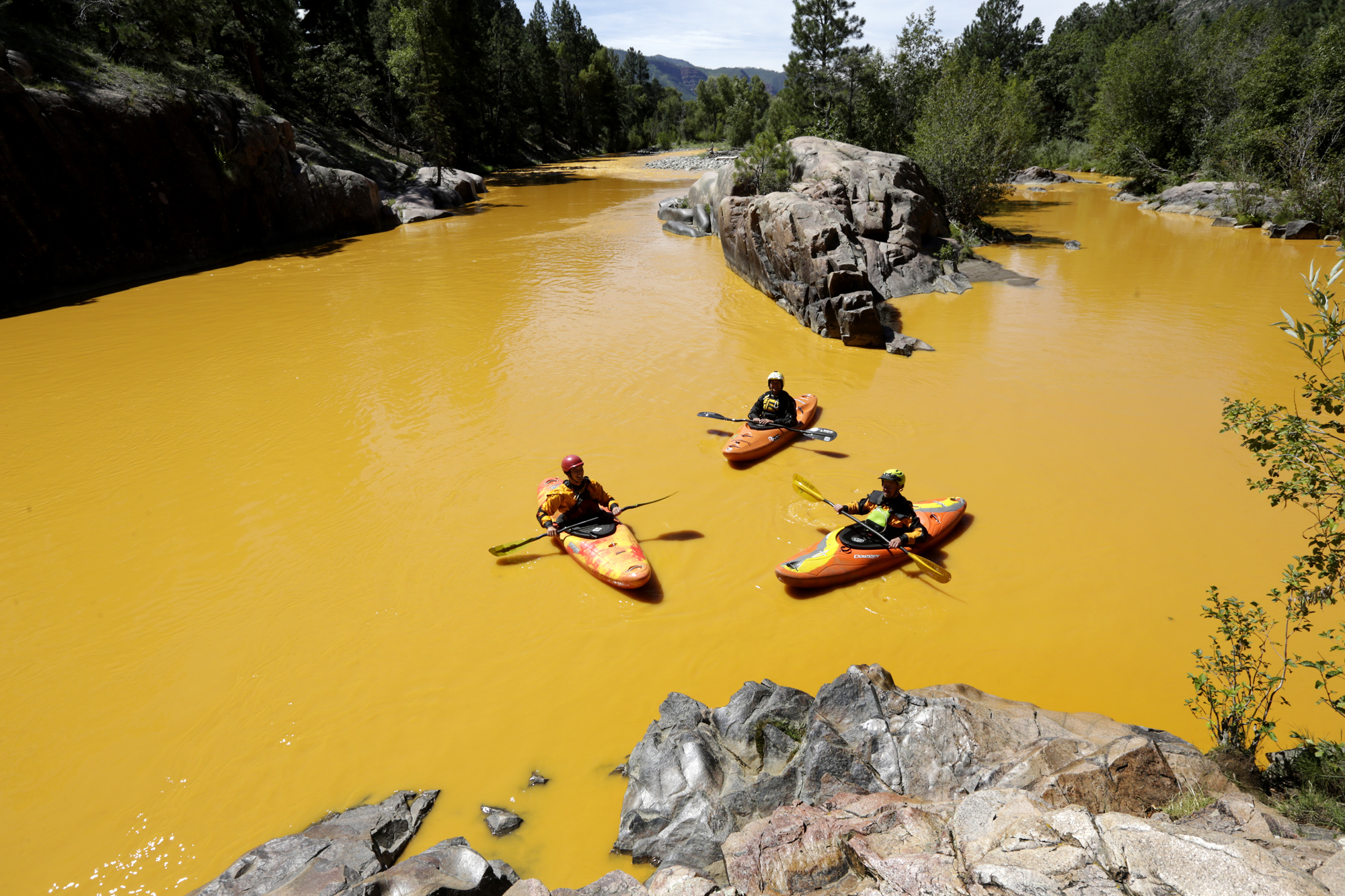
People kayak in the Animas River near Durango, Colo., Thursday, Aug. 6, 2015, in water colored from a mine waste spill. The U.S. Environmental Protection Agency said that a cleanup team was working with heavy equipment Wednesday to secure an entrance to the Gold King Mine. Workers instead released an estimated 1 million gallons of mine waste into Cement Creek, which flows into the Animas River. (Jerry McBride/The Durango Herald via AP) MANDATORY CREDIT

People Kayak the Animas River north of Durango, Thursday, August 6th, one day after the Gold King Mine spill.  Photo Jerry McBride, Durango Herald via AP 

“Koyaanisqatsi” is the Native American Hopi word for life out of balance

This is the ninth blog in a ten part series called “Through the Lens of the Animas River” that explores the August 5, 2015 Animas River spill in southwest Colorado.  Each blog in this series looks at a different aspect and deeper story behind the spill.  All Embracing Change Blog is focused on change, how to create it, embrace it and in particular the relationship between paradigms of countries, cultures and collective humanity relate to the systems we build, the patterns we see and experiences we have.  All of those are change points, areas we can influence change but require different approaches and time scales.  Learn more about a change,  paradigm shifts or play Blame It Name It Change It  r sign up for the All Embracing Change Newsletter.  The first blog was titled, “Who Really Turned My River Orange?” and second “How to Get Rid of the Environmental Protection Agency” followed by “Is the Water in the Gold King Mine a Problem?”, “To Superfund or Not to Superfund Silverton.”,“ The Perfect Response to an Orange River”, “Hello Durango, where have you been?”, “Why it Matters When a River Turns Orange” and “Why Anger Is Part of Real Change and Shame Is Not”.

On August 5, 2015 the Environmental Protection Agency (EPA) accidently released a spill of metals laden acidic mine water from the Gold King Mine.  This turned the Animas River orange and the entire country watch this butterscotch plume travel from Silverton, Colorado through Durango, on to Aztec and Farmington, New Mexico, then Bluff, Utah and into Lake Powell.  The plume also went through Southern Ute and Navajo Nation Tribal Lands.  The story went viral and international.  Perhaps that is because an orange river is an excellent visual story or maybe the irony that EPA caused a harmful spill and they are the agency responsible to protect us from such spills.

This spill happened over the anniversary for all of these events.  I connect these dots, because these events are connected to this spill and all are connected to our evolutionary growth.  We are in a deep period of evolutionary of change. The rate of change is faster and more frequent.  Systems are breaking down in every sector, health, food, education, security, economic as well as environment.  Those systems reflect paradigms that no longer serve us. Simultaneously new systems are birthing in all sectors as well. These are based on new paradigms; they are not yet the dominant paradigm.  We are in a time of conflicting paradigms and you get to choose which one to fuel.

What is common between these events and the Animas spill?    What is the message in the mess? The comparison here are not literal, not the scale of the event, the lives lost or environmental our human damage done.  They are energetic comparisons.

On August 6, 1945 the US dropped a uranium atomic bomb on Hiroshima, Japan.  On August 9th dropped a plutonium bomb on Nagasaki, Japan during the final stages of the Second World War.  The two bombings killed 129,000 people and remain the only use of nuclear weapons for warfare in history.  This was manmade destruction of mankind.   It resembles what happens on a global scale when anger and power reign out of control and violence is answered by more violence. In this case, the final violent act enabled another responsive violent act, and so the war and violence ended.  Six days after the bombing on August 15th, Japan announced its surrender to the Allies.  We have been experiencing the externalized cost of that escalation since, in the form of more deaths, environmental impacts, strained relationships and economies and so on.  Whether the harm is on this scale or the scale of the Animas, to just humans or all life, harm is being done from manmade paradigms and choices. We are the problem and the solution. It is up to us to change.

You can add up all the Animas Rivers spills in the past, the threat of 500,000 existing abandoned mines, add in rivers in Brazil and Africa and other places where natural resource extraction has killed rivers and there is no EPA to hold those accountable. Add to that the damage to our waters from other pollution sources, nitrogen, phosphorus, sediment and bacteria to name a few.  Add the assault on flows through dams and withdraws.   What we put in the air and on the land ends up in the water through the hydrologic cycle. The paradigm that water, air and land are infinite and at our disposal to use at a greater rate than can be re-generated is out dated to say the least.  The harm is done; we don’t need more studies to know what we need to change.  We need to change.

Hurricane Katrina was the 11th named storm and 5th hurricane of the 2005 Atlantic hurricane season. It was the costliest natural disaster and one of the five deadliest hurricanes in the history of the US.  Overall 1,245 people died in the hurricane and floods. Property damage estimated at $108 billion. 108 is a spiritual number.  It impacted an entire region with the most significant deaths in New Orleans, Louisiana.  Eventually 80% of the city and large tracts of neighboring parishes were flooded. Most of the property damage occurred in Mississippi beachfront towns where over 90 percent of these areas were flooded.

The failures in New Orleans is considered the worst civil engineering disaster in U.S. History and resulted in a laws suite against the U.S. Army Corps of Engineers, the designers and builders of the levee system as mandated by the Flood Control Act of 1965.  The systems put in place from this Act, implemented by U.S. Army Corp of Engineers stem directly from the paradigm of reductionism.  Reductionism is the belief that we can take anything apart, separate it from the whole, modify and change it and not deal with the consequences to the whole.  The levees interrupted a natural, capable, function hurricane surge system built by Mother Nature.  Hurricane Katrina showed us in a costly way on in an acute event that this is not true.  In January 2008, U.S. District Court Judge, Stanwood Duvall laid the responsibility for failures and flooding square on the Army Corps.  But, the federal agency could not be held financially liable because of the sovereign immunity in the Flood Control Act of 1928.  An investigation into the federal, state and local government responses resulted in the resignation of Federal Emergency Management Agency (FEMA) director Michael Brown, New Orleans Police Department Superintendent Eddie Compass.  Other agencies were commended for their actions including the U.S. Coast Guard, National Hurricane Center and National Weather Service. The coincidence of FEMA’s Director’s name Michael Brown and the shooting of Michael Brown are just freaky.

A federal agency caused harm.  Just like EPA.  Was Army Corps guilty?  Yes of causing harm.  But not from of having systems (how they built levees) from a paradigm we all supported and also benefited from.  Army Corps, unlike EPA, was unable to restore and mitigate that harm.  It remains to be seen if entities who want to take legal action against EPA will be able too.  And the paradigm we still embrace today. We expect to live in flood plains and forests that historically do burn and need to burn without losing our homes.  Or if we do, insurance will just replace it that externalizes the cost of living in these natural disaster prone areas.  All our insurance rates have increased across the country from recent hurricanes, tropical storms (Sandy) and forest fires out west.  Why, because insurance policies are risk management not risks aversion. They are not “do what you want and get out of jail free plans”.   This is the same movie playing out with different characters in the abandoned mine genera.  Ten years later and people are still homeless.  We know how it ends.  Small disasters warn, then big ones hit. The wakeup call gets louder, more frequent and costly.

The shooting of Michael Brown occurred August 9, 2015 in Ferguson, Missouri.  That was the day the Animas spill had finally passed through Durango (even though it was still traveling downstream to other communities).   Michael was an 18 year old black man fatally shot by Darren Wilson, 28 years and a white Ferguson police officer.  The disputed circumstances of the shooting and resultant protests, civil unrest went viral. Unrest is still present in Ferguson.  It ignited at debate about the relationship between law enforcement and African Americans and police use of force nationwide.

You can ask question now to determine the paradigms, or beliefs that create our police systems (protocols, policies, etc.).  This one event, and there are 100’s of others just like this one, are symptoms of a broken police system  -just like Gold King Mine spills are a symptom of broken mining systems.  This event uncorked vent up anger about our sophisticated systems that continue to repress, enslave, demean, demoralize, demonizes and ensure minorities stay poor.   Stay at status quo. Until we can hold the space for the anger that is the correct reaction to injustice, we will fuel violence and status quo.  Until we can allow for the whole truth to be spoken and accepted we will suffer the external costs of denial.  The denial that the success and wealth of our country (and European Empires) were built in part on the backs of African Americans and land stolen from Native American Tribes (we didn’t ask, we came and took).  This is part of our story and we will be better for embracing it.

Michael Browns death symbolizes all of this history and pain.  All of this history and pain is not the fault of Officer Wilson.   Officer Wilson was doing his job that day in the way he knew how under a paradigm that doesn’t work.   True justice in this case may only be known between Michael, Officer Wilson and God.   The damage, human and environmental that the legacy of abandoned mines have caused is not the fault of the EPA that day.  EPA is a product of a system operating in a paradigm that doesn’t work anymore.  For some EPA symbolizes all that is wrong with our current paradigms.  Blaming and shaming EPA will result in status quo (see Blog 8).

Each of these events provides opportunities from an unrequested wakeup call.  The Gold King Mine spill on the Animas is no different. What will be your response?

Part 10 of the “Through the Lens of the Animas River” blog series that explores the August 5, 2015 Animas River spill in southwest Colorado, is titled, “Post Traumatic Growth – What will it take to Stop Orange Rivers?”

“We cannot be selfish or timid if we hope to have a decent world for our children and grandchildren.” Jimmy Carter.

Why Anger is Part of Real Change and Shame is Not (8 of 10)

Aug 31, 2015 11:31 pm
Written by Barb Horn
0 Comments

Why Anger is Part of Real Change and Shame is Not

People kayak in the Animas River near Durango, Colo., Thursday, Aug. 6, 2015, in water colored from a mine waste spill. The U.S. Environmental Protection Agency said that a cleanup team was working with heavy equipment Wednesday to secure an entrance to the Gold King Mine. Workers instead released an estimated 1 million gallons of mine waste into Cement Creek, which flows into the Animas River. (Jerry McBride/The Durango Herald via AP) MANDATORY CREDIT

People Kayak the Animas River north of Durango, Thursday, August 6th, one day after the Gold King Mine spill.  Photo Jerry McBride, Durango Herald via AP 

“Koyaanisqatsi” is the Native American Hopi word for life out of balance

This is the eighth in a ten part series called “Through the Lens of the Animas River” that explores the August 5, 2015 Animas River spill in southwest Colorado.  Each blog in this series looks at a different aspect and deeper story behind the spill.  All Embracing Change Blog is focused on change, how to create it, embrace it and in particular the relationship between paradigms of countries, cultures and collective humanity relate to the systems we build, the patterns we see and experiences we have.  All of those are change points, areas we can influence change but require different approaches and time scales.  Learn more about a change,  paradigm shifts or play Blame It Name It Change It.  The first blog was titled, “Who Really Turned My River Orange?” and second “How to Get Rid of the Environmental Protection Agency followed by “Is the Water in the Gold King Mine a Problem?”, “To Superfund or Not to Superfund Silverton.”,“ The Perfect Response to an Orange River”, “Hello Durango, where have you been?” and “Why it Matters When a River Turns Orange”.

On August 5, 2015 the Environmental Protection Agency (EPA) accidently released a spill of metals laden acidic mine water from the Gold King Mine.  This turned the Animas River orange and the entire country watch this butterscotch plume travel from Silverton, Colorado through Durango, on to Aztec and Farmington, New Mexico, then Bluff, Utah and into Lake Powell.  The plume also went through Southern Ute and Navajo Nation Tribal Lands.  The story went viral and international.  Perhaps that is because an orange river is an excellent visual story or maybe the irony that EPA caused a harmful spill and they are the agency responsible to protect us from such spills.

Realizing the water you have played in, fished in, allowed your dogs to drink from every day, our used to water crops or livestock may not be the quality you once thought is scary.  Something out of your control cause injury to something you rely on, maybe love but definitely need incites anger.  Anger is a natural and appropriate response to injustice.  Not having information that you understand, that addresses your concerns and questions is frustrating and even infuriating.  Not knowing, who to call, who to ask, what to ask, what think or believe and who to trust, sucks.  Not knowing if you will make ends meet on your bills or in your business fuels anxiety.  We were thrown into the world of uncertainty.  As such, we are all searching for order to get rid of feeling out of control, feeling the uncomfortableness of being in the unknown.  Why can’t someone just make it all go away?  You want certainty, safety, accountability and control.

Events like this bring out every emotion available to humans.  Each individual’s experience is different, as it should be, based on their relationship to the river.  I imagine the people that day working at the mine experienced curiosity, a sense of making a difference, a focus when their started their work day.  And as the hole was drilled, earth broke away unplanned and more and more water leaked.  I imagine fear, anxiety, terror, panic and shock filled their bodies and that quickly was mixed with concern, despair, grief, sadness, compassion, responsibility, guilt, shame, worry and more fear and anxiety as the severity of the spill continued to unfold.  I imagine they even felt some anger, anger they didn’t have enough funding, enough time, the right equipment, enough of something.  It was that hurry up and wait energy. Should I be doing more while we waited and waited (30 plus hours) for the plume to arrive?  As a member of this community, a boater, a lover of rivers, I also experienced confusion, anxiety, concern, compassion, sadness, grief, anger, shock, tension, disbelief, hopelessness, exhaustion, anger, impatience and even apathy (a way to deal with stress is to check out) as the plume, politicians and higher ups all came to and through town.  These emotions, for me were not always directed at one thing, like the EPA or even the river.  They directed at me, peers, officials, the public, the media, and people on social media.

If you attended any of the public meetings or any meeting of people gathered in response to this event, you could feel the tension, confusion, fear, anger, sadness, desperation and shock in the air.  It was tempting and easy, to deal with my own emotions and reactions, to judge others reactions as somehow not accurate.  I admit, I went there a few times and remember how bitter that tastes, how I don’t like who I am when I am judging others because it is disconnecting.

I want to make several points.  First, anger is neither good nor bad, it is a vibration that can be a catalyst for change or an excuse to maintain status quo.   The choice lies within each of us every time.  Accidents are wakeup calls to something out of balance.  Something we are not able to see in the normal every day routine.  Something in our systems, and thus paradigms, that no longer serves us.  They make us stop and get out of our own way for a moment.  No one likes them and no one purposefully causes them, they are unplanned.  They are inconvenient and hurt, because that is what makes us stop.  The inconvenience, hurt and resulting feeling of being out of control creates strong reactions and emotions, including anger.  These emotions create a tension between what was and now what is. Our response to that tension is what either fuels a shift or fuels status quo.  Anger is neither good nor bad; it is just a vibration or an emotion.  What we do with our anger and tension is a choice. That choice will result is shifting anger into action to restore, heal and change for the better of all, or causes more harm, violence, injustice and retains or escalates status quo.

Holding tension is hard, never mind in a room full of angry people.  We are trained that tension is bad and must be eliminated as soon as possible. So we ignore it, numb it, keep moving so we don’t have to deal with it, we blame and shame, we shut down, repress and get depressed.  That guarantees status quo.  If we want change, want to restore injustices we not only need to create new paradigms, we need to be able to hold the space for anger and strong emotions.  It is allowing anger to be heard.

Second, understanding someone’s anger, feelings, experience, opinion and ideology is not the same as agreeing with it.  Current culture has made understanding and agreeing synonyms.  If I take the time and willingness to understand you, you and others will think I agree with you, therefore I cannot understand you.  I cannot agree with you.  This leads to demonizing others, which leads to shaming others, which leads to rationalizing continued status quo injustices, imbalances, harm, divisions, and maintaining broken systems.  It is only by understanding others anger, fear, concerns, injustices, experiences and such that we will find our common ground.  Hearing each other, understanding shows us where we are connected, because we all are connected.  I don’t ever need to agree with you or you with me to create change that benefits both of us.  You weren’t meant to have my experiences in life nor me yours, but pain is common to all humans. I can understand and hear your pain.

Third, to have anger be a catalyst for change, we have to make our world a safe place to make mistakes.  It is from mistakes we learn and grow.  Think of all the things you can do, that you once could not do. Through a series of trial and error you learn, you mastered.  Our systems are the same way, they are imperfect, always will be. Systems are implanted by people mastering that system, be it a legal, delivery, production, banking, educational, environmental or any other system.  The collective skill of people within a system is what makes that system effective or not.  Good intentions, plans, designs, processes, rules, regulation, evaluation, rewards, punishment, accountability, reflection, feedback are some elements that allow a system to make mistakes, limit harm and course correct on the way to mastering.   We have a culture now where no one can make a mistake because no one has to claim responsibility.  Someone could save the people and the planet from all maladies and if made the right mistake, that is all they would be remembered for period.

Do not confuse the need for a safe environment to make mistakes with accountability.  When a mistake causes harm, the harm needs to be restored to best possible capacity.  Healing happens in restoration, it is part of learning, growing and allowing for mistakes is what crates the change needed in the first place.  A person, system, society and culture that cannot make mistakes is one that stays stagnant, shuts down and implodes from within.  Safety to make mistakes creates an environment where anger is transformed into change.  It is safe to feel and express those feelings.  Anger and all its masked emotions begin a series of inquiries, questions, awareness that leads to willingness to make different choices.   It fuels creativity and innovation.  Environments not safe to make mistakes, not to express feelings or even feel, keeps anger repressed and locked up. This kills innovation, is divisive and causes further separation.    The only response getting attention is one that causes harm, violence. You hurt me, I am angry, I will hurt you back.  And the hurt, violence, injustice, repression, etc. cycle continues, sometimes for entire life times, decades and centuries, even escalating into wars and genocides.

The Animas spill made many angry. I was impressed that staff from the federal, state and local agencies held the space for the anger.   It allowed many to move through their anger and on to solutions.  What has impacted me the most from this incident has been the toxicity of blame and shame reactions. The river will recover, Mother Nature does not shame.

This brings me to my last point.  Shame is not a catalyst for change. Shame is not anger or guilt.  Shame is mean, destructive, disrespectful and never productive.  No one and nothing is ever deserving of shame.  Shame is also part of the human condition. We all have shamed ourselves and others and we all have been shamed by others.  We must stop believing that shame will get us what we want.  Shame always delivers more of what you don’t want. Every time.

What we want is to feel connected.  Connection leads to feeling like we belong, matter and are valued and worthy. Worthiness is an essential for inspiration, to spark ideas, make creations and risk sharing ourselves with others.   Worthiness and connection are expansive energies.

Shame is the fear of disconnection and thus, breeds more disconnection.  Shame is contracting energy, shuts down and terminates any chance of change and guarantees status quo.  Shame is the fear of not belonging, primarily because you are not worthy or good enough.  You didn’t do something, say something, wear something, or “fill in the blank – good enough”.  Shame says you are broken in a way that is out of your control to fix, you are hopeless and you will never be good enough, so don’t even try.  Shame shuts down the person shaming and the shamed.  It is a dead end.

Even worse, shame allows abdication of responsibility.  It relieves you of having to do your homework, find out more information, there is always more to a story than what is on Face book, twitter, a news article or media clip.  Always, the media makes everything black and white.  You don’t have to reach out, listen and learn, understand, uncover your responsibility in the incident.  You don’t have to change.  If I shame you then it is up to you to fix the situation.  You are broken and I don’t have to do anything.  I give up all my power to you. My happiness depends on if you change or don’t.  I feel out of control and helpless in attempt to gain control, control makes me feel connected.   The result is status quo at best, at worst, escalation of harm.  Shame screams, you hurt me so I am going to hurt you back, and expect you to change from that hurt.  And so everything stays the same, status quo.  Shame helps the mind find evidence for your beliefs, every time.  Your mind does not know if a belief is serving or hurting you, it just knows to find evidence to make your beliefs right.  You have to challenge the belief, change the belief to create change you want to experience.

If I shame BP for the Gulf Oil Spill, then I don’t have to change my relationship with oil or the paradigm that we must have cheap food, goods and energy or our country will collapse.  It is up to BP.  That is not the same as demanding and requiring BP to restore the harm caused.  BP just finished making payments to damaged communities from one settlement.  EPA needs to do the same and be given the chance to do it. So far, they are doing all the right things, maybe not perfectly (see third point) but they are showing up and trying.  This is why shaming BP has not resulted in a paradigm shift.  Neither will shaming the EPA or mining corporations.

The antidote for shame is compassion and blessing. If you find yourself shaming others and I did during this incident.  You are afraid of disconnection – that looks like losing control, predictability, hope, safety, belonging of counting.  Afraid that your view, your needs, your safety will not matter enough.  I wanted to shame all those who where shaming If you find yourself at the receiving end of shame, it is not personal.  They are projecting their fear and needs onto you.  Let them have their stories.  Let them feel. You know your truth.  If there is something you need to change, restore or take responsibility for, then do it, not because they shamed you, but because you have integrity.

To those that say EPA caused this spill on purpose and shame on them, they are the agency there to protect us from such things.  What I wanted to say was shame on you.  But I know that doesn’t help. So what I say to you is:

  • I understand how this looks like negligent cage, a conspiracy. I understand how feeds your belief that all government is bad and here to hurt, harm and torture us. I understand you feel out of control and angry.
  • I invite you to learn more, things are never as they seem. You seem to me as an angry, irrational, illogical, lazy and selfish person until I am willing to look further, because I bet you aren’t.  I bet we care about many of the same things.
  • From my experience and knowledge I know the EPA gains nothing. I invite you to hear more and broaden your understanding of the situation.  They didn’t need to cause this event to designate Silverton a Superfund site, see Blog 4.  EPA is funded by your tax dollars, allocated by Congress.  Designating a site Superfund, causing disasters does not bring any more or less money to the agency.  In fact, causing an accident creates political disharmony and threatens funding.  Funding will be taken FROM other protections, projects to fund restoration from harm caused by this spill. EPA will lose all the way around, not a win for anyone.  This has tarnished their reputation and ability to do their mission- they have nothing to gain and much to lose.  Superfund as a legislation policy—-has a section called CERCLA that does seek to gain repayment for clean up as part of holding those that caused the mess in the first place, from external costs.  If people want responsibility and accountability, Superfund/CERCLA does just that.  What goes unsaid is that all of this directly opposes the paradigm that created the mess the EPA was there to help clean up, and it creates tension to hold both paradigms in place.

I know that real live people were at the mine that day. People with families and pride.  People who have invested their careers in their expertise and brought that to the Gold King with sincere intentions to do a good job.  People who want to make a difference.  People who would never intentionally hurt anyone.  People who are human, just like you and me.  This is true of the people who were on the rig that caused the Gulf Oil Spill, who built the levees that failed in Hurricane Katrina, that were involved in any environmental disaster.  Shaming them or their agency is like pouring salt over a wound and expecting no pain and for it to heal.

Part 9 of the “Through the Lens of the Animas River” blog series that explores the August 5, 2015 Animas River spill in southwest Colorado, is titled, “What does Hiroshima, Hurricane Katrina, Michael Brown and the Animas River Have In Common?”

“We cannot be selfish or timid if we hope to have a decent world for our children and grandchildren.” Jimmy Carter.

Why It Matters When A River Turns Orange (7 of 10)

Aug 31, 2015 10:11 pm
Written by Barb Horn
0 Comments

Why It Matters When A River Turns Orange

People kayak in the Animas River near Durango, Colo., Thursday, Aug. 6, 2015, in water colored from a mine waste spill. The U.S. Environmental Protection Agency said that a cleanup team was working with heavy equipment Wednesday to secure an entrance to the Gold King Mine. Workers instead released an estimated 1 million gallons of mine waste into Cement Creek, which flows into the Animas River. (Jerry McBride/The Durango Herald via AP) MANDATORY CREDIT

People Kayak the Animas River north of Durango, Thursday, August 6th, one day after the Gold King Mine spill.  Photo Jerry McBride, Durango Herald via AP 

“Koyaanisqatsi” is the Native American Hopi word for life out of balance

This is the seventh in a ten part series called “Through the Lens of the Animas River” that explores the August 5, 2015 Animas River spill in southwest Colorado.  Each blog in this series looks at a different aspect and deeper story behind the spill.  All Embracing Change Blog is focused on change, how to create it, embrace it and in particular the relationship between paradigms of countries, cultures and collective humanity relate to the systems we build, the patterns we see and experiences we have.  All of those are change points, areas we can influence change but require different approaches and time scales.  Learn more about a change,  paradigm shifts or play Blame It Name It Change It or sign up for the All Embracing Change Newsletter.  The first blog was titled, “Who Really Turned My River Orange?” and second “How to Get Rid of the Environmental Protection Agency”followed by “Is the Water in the Gold King Mine a Problem?”, “To Superfund or Not to Superfund Silverton.”, “ The Perfect Response to an Orange River” and “Hello Durango, where have you been?”

On August 5, 2015 the Environmental Protection Agency (EPA) accidently released a spill of metals laden acidic mine water from the Gold King Mine.  This turned the Animas River orange and the entire country watch this butterscotch plume travel from Silverton, Colorado through Durango, on to Aztec and Farmington, New Mexico, then Bluff, Utah and into Lake Powell.  The plume also went through Southern Ute and Navajo Nation Tribal Lands.  The story went viral and international.  Perhaps that is because an orange river is an excellent visual story or maybe the irony that EPA caused a harmful spill and they are the agency responsible to protect us from such spills.

Why should it matter to you if a river somewhere in the world turns orange? Loses its aquatic life and biodiversity?  If a community loses its drinking water or its people get sick from the water? If entire communities, native people lose a way of life because their river is so contaminated?  If entities responsible such destruction can walk away without any accountability?   If governments can cause harm but do not have to restore harm caused?  These questions are far more extreme than the Animas River spill requires to answer, but they are connected.  The answer, is because it could happen to you, it has and is happening to you.

I am likely preaching to the choir reading this.  Water is life. We are all 80% water.  Water gives life and takes life away.  Water is power. Water creates economies and destroy economies.  Water is needed for almost every product we use and consume. From cars, to clothes, to paint, to construction materials, to paper, to electronic devices to food and the list is endless.   We all need water.  Water is a basic right.  Water is a common good.  We all have a water footprint.

Water touches everything.  What we put in the air and on the land reaches water via the hydrologic cycle.  Water is finite, not infinite, another paradigm bust.  Most of the water on the planet is in the ocean or locked up ice (global warming is changing that). What is fresh and available is less than 0.1% of all water on the planet. And all of that is not available because it is polluted beyond use and we share it with animals.  Water is a public or common good.  What you do to it impacts others and you cannot stop that impact, positive or negative.

Making water a commodity, privatizing water or making it a property right is a product of a paradigm that no longer serves us.  Water is a basic human right.  The old paradigms and associated systems will not work in the future as demands grow and supply decreases.  Supply decreases when we pollute water beyond treatment. The supply is finite.

The Animas River provides food, income, pleasure for multiple communities and tribes. It sustains life for fish, bugs, plants and animals.  When dust from overgrazed lands in Utah blows onto slopes of Colorado Mountains causing runoff of to occur two months early, that matters. That is an externalized cost of raising cattle.  These insults, however small, are not insignificant when add them up. The all reduce a finite supply of water.  They leave communities without basic rights.  The incite the world of OR, like jobs or environment, but the opportunity is to create the world of AND with associated solutions one disaster at a time.  They will add up to a critical mass that will create a paradigm shift.

That is embracing the change agent you are.  It is important we do all the small things, like recycle, reduced energy usage, eat whole nutritious local food and reduce waste.  But those actions make the best of the situation while remaining in the existing paradigm.  We need actions that change the paradigm.  That takes decades, a generation, but it stays.  A paradigm creates new social norms.  When we get a wakeup call the response is to stay awake.

Part 8 of the “Through the Lens of the Animas River” blog series that explores the August 5, 2015 Animas River spill in southwest Colorado, is titled, “Why Anger Is Part of Real Change and Shame Is Not”.

“We cannot be selfish or timid if we hope to have a decent world for our children and grandchildren.” Jimmy Carter.

Hello Durango, Where Have You Been? (6 of 10)

Aug 31, 2015 10:08 pm
Written by Barb Horn
0 Comments

Hello Durango, Where Have You Been?

People kayak in the Animas River near Durango, Colo., Thursday, Aug. 6, 2015, in water colored from a mine waste spill. The U.S. Environmental Protection Agency said that a cleanup team was working with heavy equipment Wednesday to secure an entrance to the Gold King Mine. Workers instead released an estimated 1 million gallons of mine waste into Cement Creek, which flows into the Animas River. (Jerry McBride/The Durango Herald via AP) MANDATORY CREDIT

People Kayak the Animas River north of Durango, Thursday, August 6th, one day after the Gold King Mine spill.  Photo Jerry McBride, Durango Herald via AP

“Koyaanisqatsi” is the Native American Hopi word for life out of balance

This is the sixth in a ten part series called “Through the Lens of the Animas River” that explores the August 5, 2015 Animas River spill in southwest Colorado.  Each blog in this series looks at a different aspect and deeper story behind the spill.  All Embracing Change Blog is focused on change, how to create it, embrace it and in particular the relationship between paradigms of countries, cultures and collective humanity relate to the systems we build, the patterns we see and experiences we have.  All of those are change points, areas we can influence change but require different approaches and time scales.  Learn more about a change,  paradigm shifts or play Blame It Name It Change It or sign up for the All Embracing Change Newsletter.    The first blog was titled, “Who Really Turned My River Orange?” and second “How to Get Rid of the Environmental Protection Agency” followed by “Is the Water in the Gold King Mine a Problem?”, “To Superfund or Not to Superfund Silverton.” and “ The Perfect Response to an Orange River”.

On August 5, 2015 the Environmental Protection Agency (EPA) accidently released a spill of metals laden acidic mine water from the Gold King Mine.  This turned the Animas River orange and the entire country watch this butterscotch plume travel from Silverton, Colorado through Durango, on to Aztec and Farmington, New Mexico, then Bluff, Utah and into Lake Powell.  The plume also went through Southern Ute and Navajo Nation Tribal Lands.  The story went viral and international.  Perhaps that is because an orange river is an excellent visual story or maybe the irony that EPA caused a harmful spill and they are the agency responsible to protect us from such spills.

Where was Durango before the spill? Where were any downstream communities?   We intuitively know all rivers flow downstream and someone is always upstream of you.   As previous blogs have noted, any cleanup in Silverton would first be measured and experienced in Durango, 70 miles downstream.  The recovery zone, the zone below the impact and that might resemble no impacts at all, would be in Durango.  That is because the impact was chronic (low magnitude, short duration and seasonal in frequency) that far down river.  In Silverton, concentrations caused acute (high magnitude, long duration and very frequent) exposure.

All the work by the Animas Stakeholders, Sunnyside Mine Corp, Colorado Department of Public Health and Environment, Colorado Division of Reclamation Mining and Safety, the Bureau of Land Management and Forest Service, all of whom are Animas Stakeholder members as paid off.   At Baker’s Bridge metal concentrations were statistically better than pre Stakeholder efforts.  Trout communities reflected this change too.   More trout and species of trout were found further upstream.  This was encouraging.  For background the fishery on the Animas from upstream to downstream looks like the following, keep in mind that one or two species of trout in Colorado is diverse.  A viable brook trout population resides above Silverton.  Cement Creek (where Gold King Mine resides and the American Tunnel discharged), through Silverton the Animas is void of fish, conditions are acute.  The Animas flows into a canyon and wilderness area and after some tributaries and changes in geology, a small brook trout fishery with few adults resides.  Further down the canyon before the Animas Valley, the river improves to the degree four species of trout survive, native cutthroat, brook, rainbow and brown trout.  Native scuplin and suckers exist as well.  The gradient drops once out of the Canyon and into the valley above town, which is not prime trout habitat.  Once the Animas hits Durango, the gradient picks up and primarily rainbow and brown trout reside, along with scuplin and suckers.  There is a Gold Medal Trout section on the Animas in south Durango.  This is a Colorado Parks and Wildlife designation that recognizes waters that sustain many large adult trout over a distance and time.  Below Durango, the Animas becomes a transition stream into warmer waters, flows into the San Juan which flows into Lake Powell.  This becomes habitat for warm water species as well as the four Colorado River endangered fish species.

Durango has benefited, even if they are unaware.   These benefits began to decline, in part from urban runoff, drought, elevated nutrients and other stressors, but in part due to the increased toxic water that began to drain from mines that were not draining earlier, see Blogs 1 through 4 for details. This point is really geographically broader  asking where have all the impacted communities been?  In the 2002 drought and before there were efforts to host a San Juan River Forum to address water quality issues from a regional perspective but never gained enough momentum to work effectively across jurisdictional boundaries.

What makes this more interesting about Durango, is this spill was not the first.  We humans have short memories.  Durango used to get their drinking water from the Animas River.  Durango grew during the Gold Rush and the economy depended on and supported mining in Silverton.  Durango had its own mining legacy.  Between 1942 and 1946, on Smelter Mountain, vanadium ore was processed and uranium ore processed from 1949-1963.  The site became a Department of Energy site from 1948 – 1953.  Because it was a Department of Energy site, it was eligible for cleanup under the Uranium Mill Tailings Remedial Action (UMTRA) Projects.  Soils were moved to disposal sites, vegetation and topsoil renewed after all buildings and structures were long gone.  The site is now home to Durango’s dog park and is adjacent to the Animas River.

Long before uranium mining was profitable, the Animas River and Durango was impacted by a polluted Animas River.  The source, active mining in Silverton.  This is not good or bad, just was.  Mines in Silverton were using the best practices of the times and that included using the river to send your waste downstream.   Durango did use the Animas River as a drinking water source in those days, until they couldn’t.  At some point the river in Durango was so fouled with mine waste, rather than deal with changing mine operations or other approaches, Durango built a reservoir one watershed to the east and piped in clean drinking water.

Today, Durango only uses a small portion of the Animas River in the summer when demand is high for drinking water and urban uses.  That water is mixed with Florida River water and delivered to town residents.  The recent spill shut off that intake and Durango officials asked residents to conserve water.  Conserve they did, cutting back usage by 70%, a whopping 70%.  That was for a week.  Many residents questioned the reopening of the river after the spill for drinking water, in part due to the unknowns about the sediments still, but in part because residents demonstrated they could conserve.  So, let them under the guise of more certainty.  .Open the river next year.  One thing is sure, most residents did not know where their drinking water came from.  Nor did they understand that their drinking water is tested far more rigorously than bottled water.  Suffice it to say, they know now.

Still curious to me is the response. It is true Durango has grown and people have left, so many may not remember previous Animas River spills.  In June of 1975, a huge tailings pile on the banks of the upper Animas River northeast of Silverton was breached.  This released over ten thousand gallons of water, along with an estimated 50,000 tons of metal laden tailings into the river.  For 100 miles downstream the river “looked like aluminum paint” according to the Durango Herald.  Fish placed in sentinel cages then all died within 24 hours.  Compared to this spill, 3 million gallons, more than 100 miles traveled and sentinel rainbow trout fry survived the 96 hour exposure.

There were numerous breaches like this of various magnitudes. Ten years before this breach, the same tailings pile was found to be leaching cyanide laced water into the River.  In 1978, Sunnyside Gold Corp mine workings got to close to the bottom (underground) of Lake Emma and the lake fell through the mine and burst out about 500 million gallons of water, raging through the mines, sweeping up huge machinery, tailings and sludge and blasted out the American Tunnel downstream to Durango.  This happened during the evening so no lives were lost but some could have been.

A new normal is set. The spill moved the recovery zone back downstream and delayed in time.  Many were inconvenienced and just want EPA, Superfund or whomever to take care of it all so they can go back to their bubble.   That is not okay.  There is no such thing as an insulated bubble.  Everyone must stay awake until the job is done.  The accidental EPA spill from the Gold King Mine has Durango’s attention now. That attention needs to be funneled into constructive long term change to provide a sense of peace.  If people want a sense of peace that means business as usual and someone else take care of this, that is kicking the can down the road.  A real, long term sense of piece means doing something different, all of us.  After visiting the Lower Ninth Ward on the Anniversary of Katrina, August 29th this year. They are suffering already from flood amnesia.  Parts of the arid southwest are in drought amnesia.  This area, and all headwater communities as well as all Colorado citizens have had legacy mining amnesia.

Part 7 of the “Through the Lens of the Animas River” blog series that explores the August 5, 2015 Animas River spill in southwest Colorado, is titled, “Why it Matters When A River Turns Orange”.

“We cannot be selfish or timid if we hope to have a decent world for our children and grandchildren.” Jimmy Carter.

Page 8 of 12

  • Previous
  • 1
  • 2
  • 3
  • 4
  • 5
  • 6
  • 7
  • 8
  • 9
  • 10
  • 11
  • 12
  • Next

Quick Links

Blog
Newsletter
Store
Contact Barb

Say ‘Yes’ to You

All Embracing Change

Contact Barb

Barb Horn, Certified Alchemical Hypnotherapist, SoulCollage Facilitator, Inspirational Speaker, and Ceremonialist
Offering personalized experience via phone or at your location.
+1(970)903-3029
All Embracing Change
10 Town Plaza, #183
Durango, CO 81301, USA
© Copyright 2015 -   by All Embracing Change, Website by Yoka Design
This website uses cookies to improve your experience. Accept
Privacy & Cookies Policy

Privacy Overview

This website uses cookies to improve your experience while you navigate through the website. Out of these, the cookies that are categorized as necessary are stored on your browser as they are essential for the working of basic functionalities of the website. We also use third-party cookies that help us analyze and understand how you use this website. These cookies will be stored in your browser only with your consent. You also have the option to opt-out of these cookies. But opting out of some of these cookies may affect your browsing experience.
Necessary
Always Enabled
Necessary cookies are absolutely essential for the website to function properly. This category only includes cookies that ensures basic functionalities and security features of the website. These cookies do not store any personal information.
Non-necessary
Any cookies that may not be particularly necessary for the website to function and is used specifically to collect user personal data via analytics, ads, other embedded contents are termed as non-necessary cookies. It is mandatory to procure user consent prior to running these cookies on your website.
SAVE & ACCEPT